
Low Stock vs Stockout Risk Explained
Understand the difference between low stock signals and stockout risk, and why both matter for WooCommerce operations.
Incident Detection | May 23, 2026
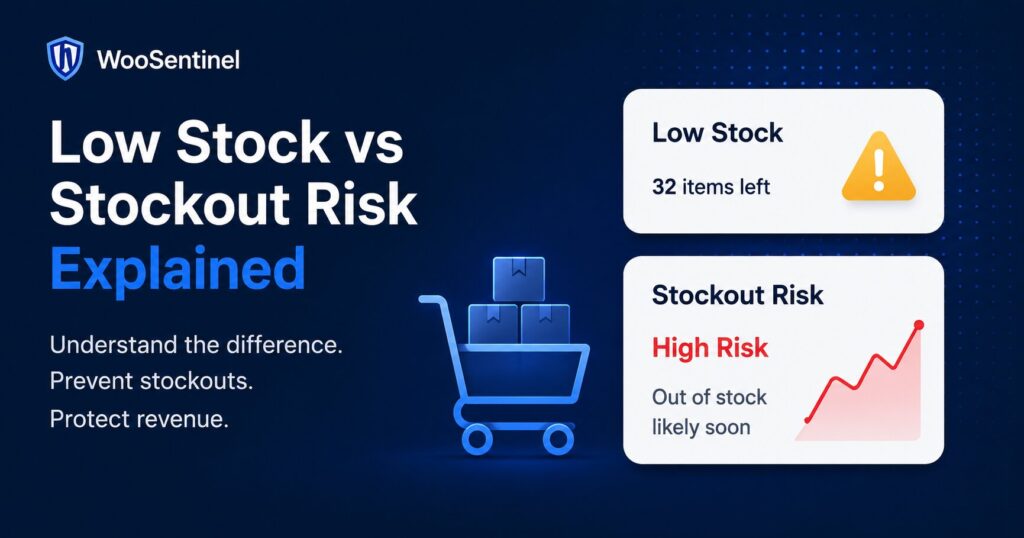
WooCommerce Stockout Risk is one of the clearest inventory signals a WooCommerce team can monitor, but it is not the same as stockout risk. Low stock usually means available inventory has dropped below a threshold. Stockout risk asks a more operational question: could this product run out before the team responds? WooSentinel uses WooCommerce monitoring and incident detection to surface inventory-related issues alongside store health, sync status, revenue movement, AI Copilot context, and AI Action Queue recommendations. That helps teams review inventory signals before they become missed sales opportunities. The important safety boundary is that WooSentinel does not automatically change stock quantities or product settings. It monitors, detects, explains, and prepares recommended checks for human review.
Why Low Stock Monitoring Matters
Inventory issues affect customer experience and revenue. A product can be technically available but close enough to running out that the team needs to act. Another product may have low stock but low sales velocity, making it less urgent. Monitoring helps separate attention-worthy risk from routine inventory noise. Low stock and stockout risk also connect to Revenue Watch. If a top product declines, inventory status may be one of the first things to check. If orders slow down, stock pressure or product availability may help explain the pattern. A careful monitoring workflow gives teams context without making risky automatic changes. Humans still decide whether to reorder, update product pages, contact suppliers, or adjust operations.
Low Stock and Stockout Risk Signals to Monitor
Useful WooCommerce operations monitoring starts with signals that help a team decide whether an issue needs review. The exact priority depends on the store, plan, and workflow, but these signals are a practical starting point.
- products below configured low stock thresholds
- products with stockout risk based on operational context
- top products with revenue decline or unusual movement
- sync freshness for product and stock data
- Revenue Watch incidents connected to product-level changes
- AI Action Queue reorder checklists or product review hints
- AI Copilot questions about inventory and revenue impact
Practical example
A store has two products with low stock. Product A sells every day and contributes meaningful revenue. Product B sells rarely. Treating both the same can waste attention. Stockout risk helps the team prioritize Product A because running out may create a faster revenue or customer experience issue. WooSentinel can surface the inventory signal, connect it with revenue movement where available, and prepare a checklist or supplier email draft through AI Action Queue. The team still reviews and decides what to do.
How WooSentinel helps
WooSentinel brings WooCommerce monitoring, incident detection, Revenue Watch, AI Copilot, and AI Action Queue workflows into one product-led operating layer. The purpose is to help teams understand what changed and review what to do next, not to replace human judgment.
- detects low stock and stockout risk incidents
- connects inventory signals with store health, sync status, and Revenue Watch context
- helps prioritize products that may affect revenue or customer experience
- supports deterministic recommendations for inventory review
- can prepare AI Action Queue hints, checklists, or drafts for human review
- keeps product stock changes out of automatic execution
Deterministic fallback and AI controls
Deterministic monitoring is the baseline. WooSentinel can detect many store health, sync, stock, incident, and revenue signals without requiring OpenAI-enhanced analysis. Where OpenAI-assisted features are available, they depend on plan permissions, wallet balance, and AI controls. This approach gives teams a safer balance. They can use wallet-controlled AI for deeper explanations and recommendations when it fits the workflow, while still keeping rule-based monitoring and operational context available when AI is disabled or unavailable.
Human-reviewed action model
WooSentinel uses a human-reviewed workflow for prepared actions. AI Action Queue can create summaries, product review hints, store health checks, reorder checklists, or draft supplier emails, but users review the recommendation before deciding what to approve, execute safely, or dismiss. Risky WooCommerce writes do not happen automatically. WooSentinel does not automatically change products, orders, refunds, stock, checkout, login, or billing settings as part of these monitoring workflows.
Operational checklist for teams
Use this checklist to turn the topic into a practical review habit for store owners, agencies, or eCommerce teams.
- Define low stock thresholds that match how each product sells.
- Review top products more often than slow-moving products.
- Check sync freshness before trusting stock-related incident context.
- Compare product revenue movement when stock risk appears.
- Use AI Action Queue recommendations as review prompts, not automatic instructions.
- Document who approves reorder decisions or supplier communication.
Continue Exploring WooCommerce Monitoring
Learn more about WooCommerce monitoring, incident detection,
revenue protection, AI Action Queue, Revenue Watch, pricing,
security, and operational workflows.
WooCommerce Monitoring Platform
Learn how WooSentinel helps monitor store health, detect
operational incidents, protect revenue, and prepare
AI-assisted actions for review.
WooCommerce Monitoring Features
Explore Revenue Watch, AI Action Queue, AI Copilot,
incident detection, store health monitoring,
and revenue protection tools.
WooCommerce Monitoring Pricing
Compare plans, AI access, wallet controls,
store limits, and support options for
WooCommerce monitoring.
WooCommerce Monitoring Use Cases
See how WooSentinel helps store owners,
agencies, multi-store operators, and
enterprise WooCommerce teams.
WooCommerce Monitoring Security
Learn about store access, AI controls,
Revenue Watch boundaries, billing transparency,
and operational trust.
WooCommerce Monitoring FAQ
Find answers about Revenue Watch,
AI Action Queue, AI billing, plans,
incidents, and WooCommerce monitoring.
FAQ
What does low stock mean?
Low stock means a product has dropped below a configured or expected inventory threshold.
How is stockout risk different?
Stockout risk considers whether a product may run out before the team responds, especially when demand or revenue importance makes the issue more urgent.
Can WooSentinel change stock automatically?
No. WooSentinel does not automatically change product stock or product settings. It monitors and prepares recommendations for human review.
Can inventory issues affect Revenue Watch?
Yes. Product-level declines and revenue movement may be connected to availability or inventory pressure, so inventory checks can be part of revenue incident review.
Can low stock affect customer experience?
Yes. Products that remain available but are close to running out can create fulfillment delays, missed sales opportunities, and customer frustration if inventory is not reviewed in time.
Where can I learn more about incident detection?
Visit features or FAQ for more on WooCommerce incident detection.
Start monitoring WooCommerce operations with more context
WooSentinel helps teams monitor WooCommerce operations, detect revenue movement, review incidents, and use human-reviewed AI workflows with safer controls. Start Free Trial or compare plans on the pricing page.
Ready to detect WooCommerce issues before they affect revenue?
Use WooSentinel to monitor store health, detect incidents, and understand what to fix first.