
How to Monitor WooCommerce Store Health
A practical outline for monitoring store health signals, activity, sync freshness, and operational risk in WooCommerce.
Store Health | May 23, 2026
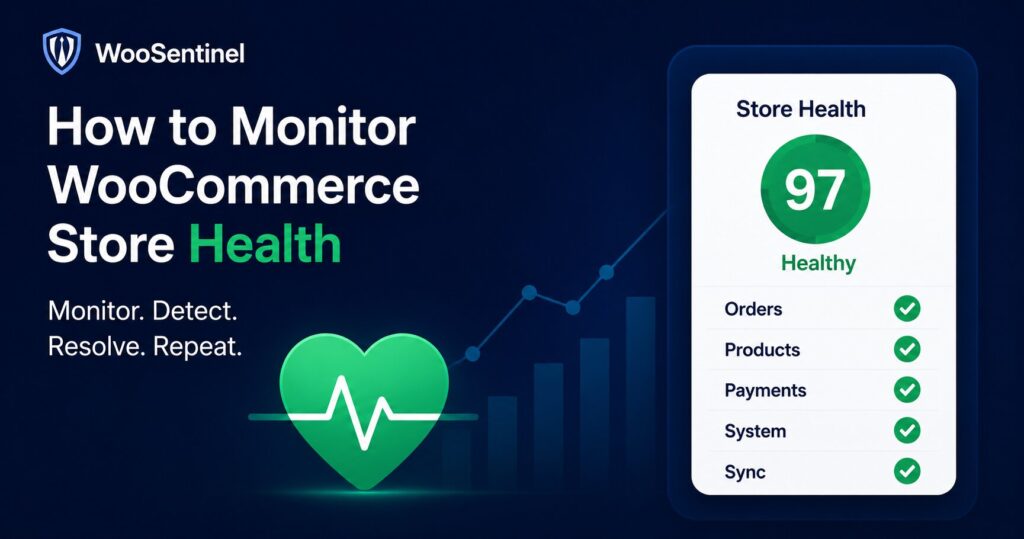
WooCommerce store health is the operational picture of whether a store is fresh, active, connected, and showing the signals a team needs to trust daily decisions. It includes more than uptime. Store health includes sync status, orders, products, stock, revenue movement, incidents, alerts, and monitoring freshness.
WooSentinel helps teams monitor WooCommerce store health alongside Revenue Watch, AI Copilot, AI Action Queue, and incident detection. The goal is to help store owners, agencies, and eCommerce teams spot operational risk before it becomes harder to investigate.
A healthy store monitoring workflow does not automatically change WooCommerce. It surfaces context, prepares recommended checks, and keeps humans in control of what happens next.
Why WooCommerce Store Health Matters
Store health matters because many WooCommerce issues begin as weak signals. A sync is stale, order activity slows down, a product runs low, or revenue movement changes. None of these always means the store is broken, but each deserves context.
Monitoring store health gives teams a regular operating rhythm. Instead of waiting for a customer complaint or manually checking reports, the team can review the most important signals from one layer.
This also improves AI-assisted workflows. AI Copilot and AI Action Queue are more useful when they can reference current store health, incident status, and revenue movement.
WooCommerce Store Health Signals to Monitor
Useful WooCommerce operations monitoring starts with signals that help a team decide whether an issue needs review. The exact priority depends on the store, plan, and workflow, but these signals are a practical starting point.
- store connection and sync freshness
- recent order activity and no_orders_recent signals
- product freshness, low stock, and stockout risk
- sync_failure incidents and API connection context
- Revenue Watch alerts and Revenue Pulse emails
- AI Copilot explanations for incidents and store health
- AI Action Queue recommendations for human-reviewed follow-up
Practical example
A store appears normal, but no orders have arrived for several hours. That might be expected, or it might point to a checkout, campaign, stock, or sync issue. Store health monitoring helps the team review activity, freshness, and related incidents before jumping to conclusions.
If Revenue Watch also detects a revenue drop, the team has more context. AI Action Queue may prepare recommended checks such as confirming sync status, reviewing top products, and checking recent order activity. A human still decides what to do.
How WooSentinel helps
WooSentinel brings WooCommerce monitoring, incident detection, Revenue Watch, AI Copilot, and AI Action Queue workflows into one product-led operating layer. The purpose is to help teams understand what changed and review what to do next, not to replace human judgment.
- monitors WooCommerce store health signals across connected stores
- surfaces incidents for sync failure, stock risk, order inactivity, and revenue movement
- uses Revenue Watch to connect store health with revenue comparisons
- lets teams ask AI Copilot questions about incidents and store state
- prepares AI Action Queue recommendations for human review
- keeps deterministic monitoring available even when OpenAI-enhanced analysis is disabled
Deterministic fallback and AI controls
Deterministic monitoring is the baseline. WooSentinel can detect many store health, sync, stock, incident, and revenue signals without requiring OpenAI-enhanced analysis. Where OpenAI-assisted features are available, they depend on plan permissions, wallet balance, and AI controls.
This approach gives teams a safer balance. They can use wallet-controlled AI for deeper explanations and recommendations when it fits the workflow, while still keeping rule-based monitoring and operational context available when AI is disabled or unavailable.
Human-reviewed action model
WooSentinel uses a human-reviewed workflow for prepared actions. AI Action Queue can create summaries, product review hints, store health checks, reorder checklists, or draft supplier emails, but users review the recommendation before deciding what to approve, execute safely, or dismiss.
Risky WooCommerce writes do not happen automatically. WooSentinel does not automatically change products, orders, refunds, stock, checkout, login, or billing settings as part of these monitoring workflows.
Operational checklist for teams
Use this checklist to turn the topic into a practical review habit for store owners, agencies, or eCommerce teams.
- Review connection and sync freshness before trusting operational data.
- Check recent order activity and compare it with normal store behavior.
- Watch low stock and stockout risk for important products.
- Review Revenue Watch movement daily, weekly, and monthly.
- Use incidents to prioritize which store health signals matter most.
- Use human-reviewed AI recommendations carefully and avoid automatic store changes.
Continue Exploring WooCommerce Monitoring
Learn more about WooCommerce monitoring, incident detection,
revenue protection, AI Action Queue, Revenue Watch, pricing,
security, and operational workflows.
WooCommerce Monitoring Platform
Learn how WooSentinel helps monitor store health, detect
operational incidents, protect revenue, and prepare
AI-assisted actions for review.
WooCommerce Monitoring Features
Explore Revenue Watch, AI Action Queue, AI Copilot,
incident detection, store health monitoring,
and revenue protection tools.
WooCommerce Monitoring Pricing
Compare plans, AI access, wallet controls,
store limits, and support options for
WooCommerce monitoring.
WooCommerce Monitoring Use Cases
See how WooSentinel helps store owners,
agencies, multi-store operators, and
enterprise WooCommerce teams.
WooCommerce Monitoring Security
Learn about store access, AI controls,
Revenue Watch boundaries, billing transparency,
and operational trust.
WooCommerce Monitoring FAQ
Find answers about Revenue Watch,
AI Action Queue, AI billing, plans,
incidents, and WooCommerce monitoring.
FAQ
What is WooCommerce store health?
WooCommerce store health is the combined view of connection, sync freshness, order activity, product and stock signals, revenue movement, and incidents.
Is store health the same as uptime?
No. Uptime matters, but store health also includes operational signals such as sync status, stock risk, order activity, and revenue movement.
Can AI help monitor store health?
AI can help explain incidents and prepare recommended checks where plan, wallet, and controls allow, but deterministic monitoring remains the baseline.
Does WooSentinel change my store automatically?
No. WooSentinel monitors and prepares recommendations. Risky WooCommerce changes do not happen automatically.
How often should WooCommerce store health be reviewed?
Most stores should review store health daily, while agencies and multi-store teams may review key signals multiple times per day depending on store activity and operational risk.
What affects WooCommerce store health?
Store health can be affected by sync freshness, order activity, product availability, stock levels, revenue movement, API connectivity, incidents, and monitoring visibility.
Where can I learn more?
Start with features, review security, or compare plans on pricing.
Start monitoring WooCommerce operations with more context
WooSentinel helps teams monitor WooCommerce operations, detect revenue movement, review incidents, and use human-reviewed AI workflows with safer controls. Start Free Trial or compare plans on the pricing page.
Ready to detect WooCommerce issues before they affect revenue?
Use WooSentinel to monitor store health, detect incidents, and understand what to fix first.