
Introducing Revenue Watch: Revenue Monitoring for WooCommerce Stores
Learn how Revenue Watch monitors WooCommerce revenue movement, alerts, incidents, Revenue Pulse emails, and AI analysis.
Revenue Watch | June 2, 2026
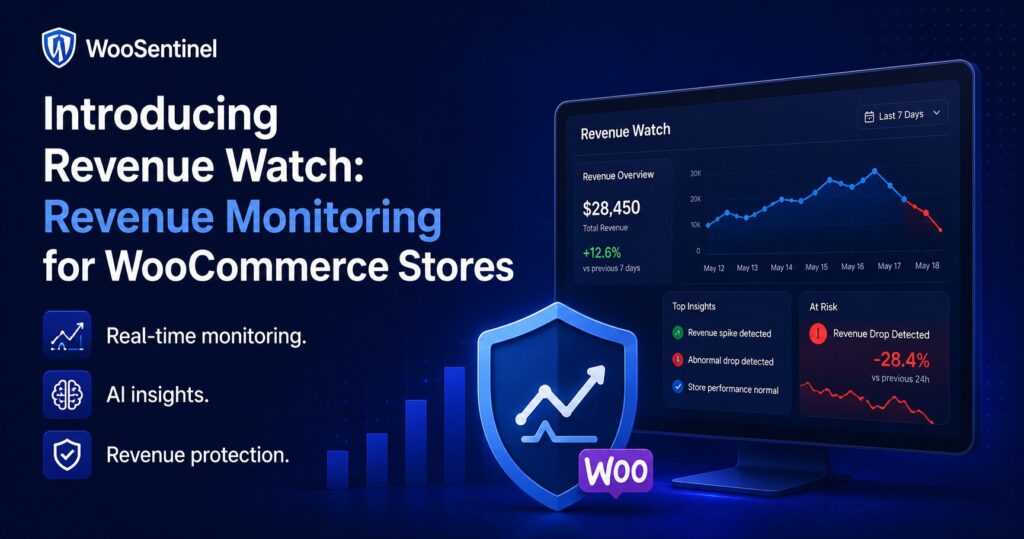
WooCommerce revenue monitoring helps store teams detect revenue drops, order changes, AOV movement, product declines, and alerts before issues become harder to review.
Revenue problems rarely announce themselves clearly. A store can look healthy at a glance while orders slow down, average order value changes, or a top product quietly drops below its normal pattern. Revenue Watch is WooSentinel’s revenue monitoring workflow for WooCommerce teams that want earlier visibility into those changes. It compares daily, weekly, and monthly movement, turns meaningful changes into alerts or incidents, and helps teams understand what deserves attention.
This guide explains the concept, the operational signals to watch, and how WooSentinel approaches the workflow carefully. It is written for store owners, agencies, and eCommerce teams evaluating WooCommerce monitoring, WooCommerce incident detection, and revenue protection without handing risky store changes to automation.
Why WooCommerce Revenue Monitoring Matters
WooCommerce store owners often review revenue after the problem has already affected the day, week, or month. Traditional reports are useful, but they depend on someone remembering to check them. Revenue Watch is designed to bring revenue movement into the same operational layer as store health, stock, sync status, incidents, and AI-assisted guidance.
WooCommerce teams are often busy with fulfillment, product updates, customer questions, campaigns, and supplier communication. When operational risk is hidden inside separate reports or admin screens, small issues can sit unnoticed. Monitoring brings those signals into a repeatable review process so the team can decide what needs attention first.
The important distinction is that visibility is not the same as automatic repair. WooSentinel is designed to monitor, detect, explain, and prepare recommended checks. Risky WooCommerce actions such as changing product stock, editing orders, issuing refunds, or changing checkout settings do not happen automatically.
WooCommerce Revenue Monitoring Signals to Watch
A good operational workflow looks for patterns that affect revenue, customer experience, or team workload. Depending on the store and plan, these signals may include:
- daily revenue compared with the previous daily period
- weekly revenue movement compared with the prior week
- monthly revenue movement compared with the prior month
- order volume changes and average order value changes
- top product revenue declines and unusual product movement
- Revenue Pulse email summaries and revenue drop alerts
- Revenue Watch incidents when changes deserve operational follow-up
Practical example
Imagine a store where total revenue is lower than normal, but the team only sees the problem at the end of the week. Revenue Watch can highlight the drop earlier, connect it to order volume or product movement, and create a clearer path for review. The goal is not to promise automatic recovery. The goal is to make revenue risk visible while there is still time to investigate.
In practice, the best response is usually a set of checks rather than a single assumption. Teams may review store health, order freshness, product availability, sync status, revenue movement, recent product changes, and notification settings. A structured workflow reduces guesswork and makes it easier to explain why a specific issue was prioritized.
How WooSentinel helps
WooSentinel connects WooCommerce monitoring with incident detection, Revenue Watch, AI Copilot guidance, and AI Action Queue workflows. The product-led goal is simple: help teams see what changed, understand why it might matter, and review safe next steps from one operational layer.
WooSentinel uses WooCommerce revenue monitoring through Revenue Watch to connect revenue comparisons, alerts, incidents, Revenue Pulse emails, AI analysis, and deterministic fallback in one workflow.
- creates deterministic revenue comparisons for supported operational plans
- surfaces revenue alerts for drops, order changes, AOV movement, and product declines
- can send Daily Revenue Pulse, Weekly Revenue Pulse, Monthly Revenue Watch, and revenue drop emails based on settings
- can create Revenue Watch incidents with impact context and recommended checks
- supports OpenAI-enhanced analysis for eligible Business, Premium, and Enterprise stores when wallet balance and AI controls allow
- keeps deterministic fallback available when OpenAI-enhanced analysis is not available
Deterministic fallback and AI controls
WooSentinel keeps deterministic monitoring and rule-based insight available so teams are not dependent on OpenAI-enhanced analysis for every workflow. Where OpenAI-assisted features are available, they depend on plan permissions, wallet balance, and AI controls. This helps protect tenant spending and keeps advanced AI usage visible.
Human-reviewed action model
AI Action Queue is intentionally human-in-the-loop. AI can prepare summaries, recommended checks, and drafts, but users review actions before execution. Safe internal actions can be recorded after approval, while risky WooCommerce writes are not performed automatically.
Operational checklist for teams
When evaluating this workflow, start by deciding which signals should create an alert and which should become an incident. A single small movement may only need a note, while a larger revenue drop, repeated sync failure, or high-priority stock risk may deserve a structured incident.
Next, define who reviews each type of issue. Store owners may handle product and supplier checks directly, agencies may route work by client account, and larger teams may separate revenue review from technical troubleshooting. The value of monitoring increases when alerts turn into clear ownership.
Finally, keep AI usage intentional. Use deterministic monitoring as the baseline. Use AI-enhanced explanations where the plan, wallet, and controls allow, especially when a team needs faster summaries, likely drivers, or recommended investigation paths. This creates a safer balance between speed and governance.
Continue Exploring WooCommerce Monitoring
Learn more about WooCommerce monitoring, incident detection,
revenue protection, AI Action Queue, Revenue Watch, pricing,
security, and operational workflows.
WooCommerce Monitoring Platform
Learn how WooSentinel helps monitor store health, detect
operational incidents, protect revenue, and prepare
AI-assisted actions for review.
WooCommerce Monitoring Features
Explore Revenue Watch, AI Action Queue, AI Copilot,
incident detection, store health monitoring,
and revenue protection tools.
WooCommerce Monitoring Pricing
Compare plans, AI access, wallet controls,
store limits, and support options for
WooCommerce monitoring.
WooCommerce Monitoring Use Cases
See how WooSentinel helps store owners,
agencies, multi-store operators, and
enterprise WooCommerce teams.
WooCommerce Monitoring Security
Learn about store access, AI controls,
Revenue Watch boundaries, billing transparency,
and operational trust.
WooCommerce Monitoring FAQ
Find answers about Revenue Watch,
AI Action Queue, AI billing, plans,
incidents, and WooCommerce monitoring.
FAQ
What is Revenue Watch?
Revenue Watch is WooSentinel’s workflow for comparing WooCommerce revenue movement across daily, weekly, and monthly periods and surfacing meaningful changes.
Does Revenue Watch require visitor tracking?
No. The current Revenue Watch workflow uses synced WooCommerce order and product data. It does not require abandoned cart or visitor behavior tracking.
What are Revenue Pulse emails?
Revenue Pulse emails are proactive summaries such as Daily Revenue Pulse, Weekly Revenue Pulse, Monthly Revenue Watch, and revenue drop alerts.
Can Revenue Watch use AI?
Business, Premium, and Enterprise stores can use OpenAI-enhanced revenue analysis where plan permissions, wallet balance, and AI controls allow.
What happens if AI is unavailable?
WooSentinel can use deterministic fallback so revenue comparisons and operational monitoring remain available without OpenAI-enhanced analysis.
Start monitoring WooCommerce operations with more context
WooSentinel helps teams monitor WooCommerce operations, detect revenue movement, and review AI-prepared actions without sending checkout, login, or billing logic through the marketing site. Start Free Trial or compare the details on the pricing page.
For teams building a more reliable WooCommerce operations process, the key is consistency. Review incidents daily, confirm notification settings, keep store connections healthy, and document which checks should happen before a customer-facing issue escalates. WooSentinel is built to support that discipline with monitoring, recommended checks, internal links between workflows, and clear controls around OpenAI-enhanced features
Ready to detect WooCommerce issues before they affect revenue?
Use WooSentinel to monitor store health, detect incidents, and understand what to fix first.